Workday · Generative AI
Performance Management Agent
Managers spend an annual average of 210 hours writing performance reviews. Performance Management Agent was built to change that.
Role
Timeline
Team
Lead product designer
EA release • Feb 2026
Product, ML, eng, research
Context
Performance Management is a core part of Workday’s Talent Optimization product, helping organizations evaluate performance and support career growth across features like reviews, goals, feedback, calibration, and check-ins.
This phase of Performance Management Agent focused specifically on helping managers prepare and write employee evaluations more efficiently.
Problem
On average, managers spend over 210 hours annually preparing and writing performance reviews. Through multiple rounds of user research and customer interviews, the same two pain points consistently surfaced:
Time spent gathering data
Managers spend significant time searching across systems to collect relevant information on each direct report before they can even begin writing.
Difficulty drafting reviews
Synthesizing that information into a coherent, well-written evaluation requires substantial effort, and managers are doing it for every person on their team.
The question was whether AI could genuinely reduce that burden or just add a new one.
Scope
The Performance Management Agent was envisioned as a broader AI assistant across the full performance management workflow – reviews, goals, feedback, calibration, and check-ins. For the February 2026 early adopter release, the focus was scoped specifically to performance reviews.
The intended experience had two parts: a pre-generated draft when the manager landed on the review, and an AI conversation panel that would allow managers to regenerate content, ask questions, and explore the sources behind the draft.
Due to technical constraints, the conversation panel was cut from the early adopter release. That constraint forced us to focus on making sure the generated draft and sources were strong enough on their own to save managers time and support the writing process.
Agent workflow
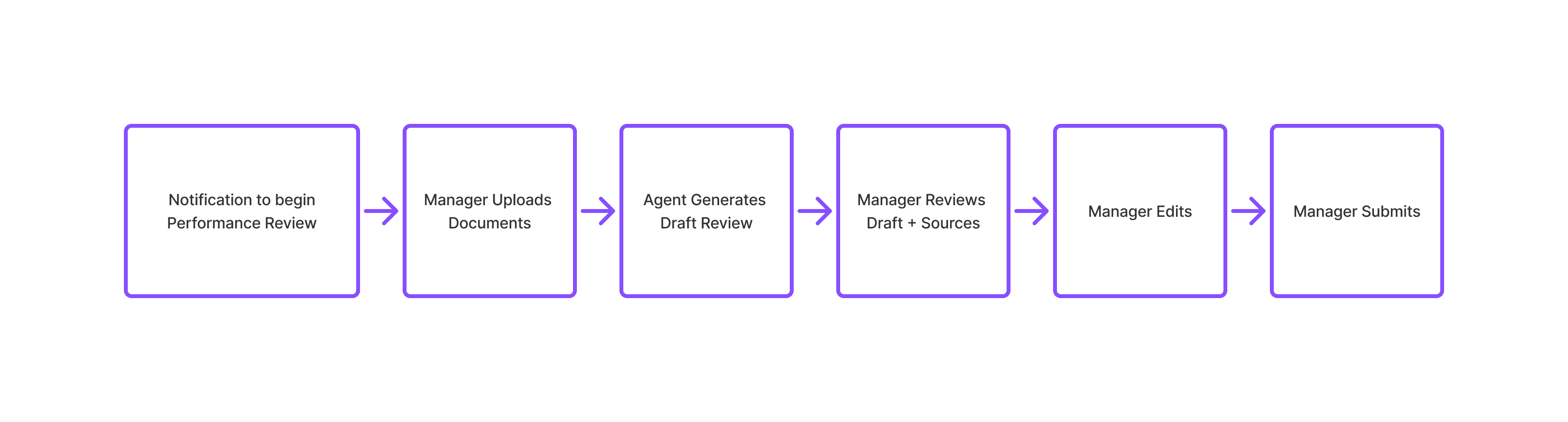
In production
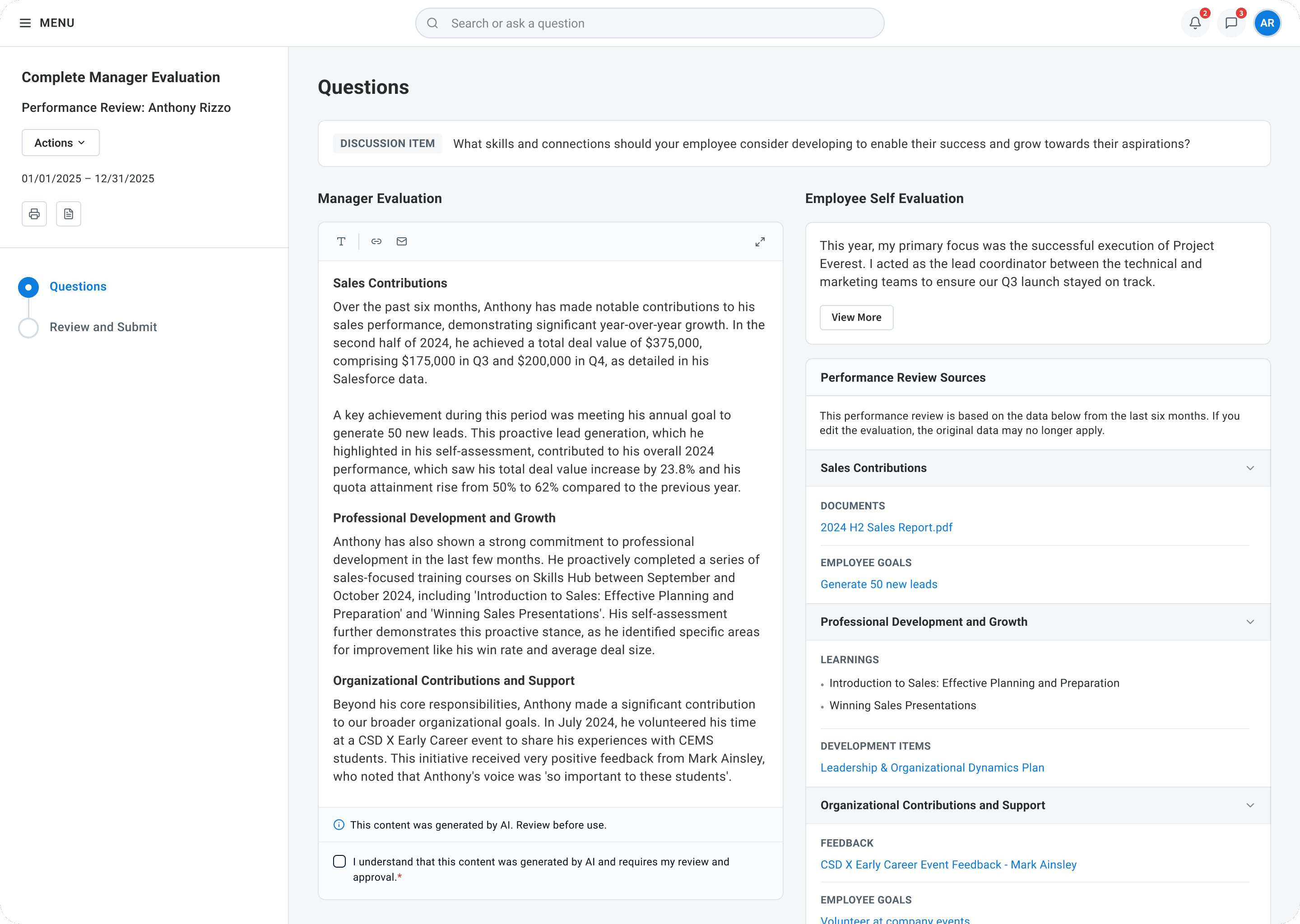
Key Decisions
Decision 1: Scoping down to the pre-generated draft
Context
The original EA scope included both the pre-generated draft and an AI conversation panel. When the panel was cut due to technical constraints, the team faced a choice: delay the release, or move forward with a more limited experience and figure out how to make it valuable on its own.
Decision
Rather than delay, the team aligned on a focused outcome: validate whether a pre-generated draft and sources alone were strong enough to save managers meaningful time. The draft became the core value proposition for EA.
Original concept
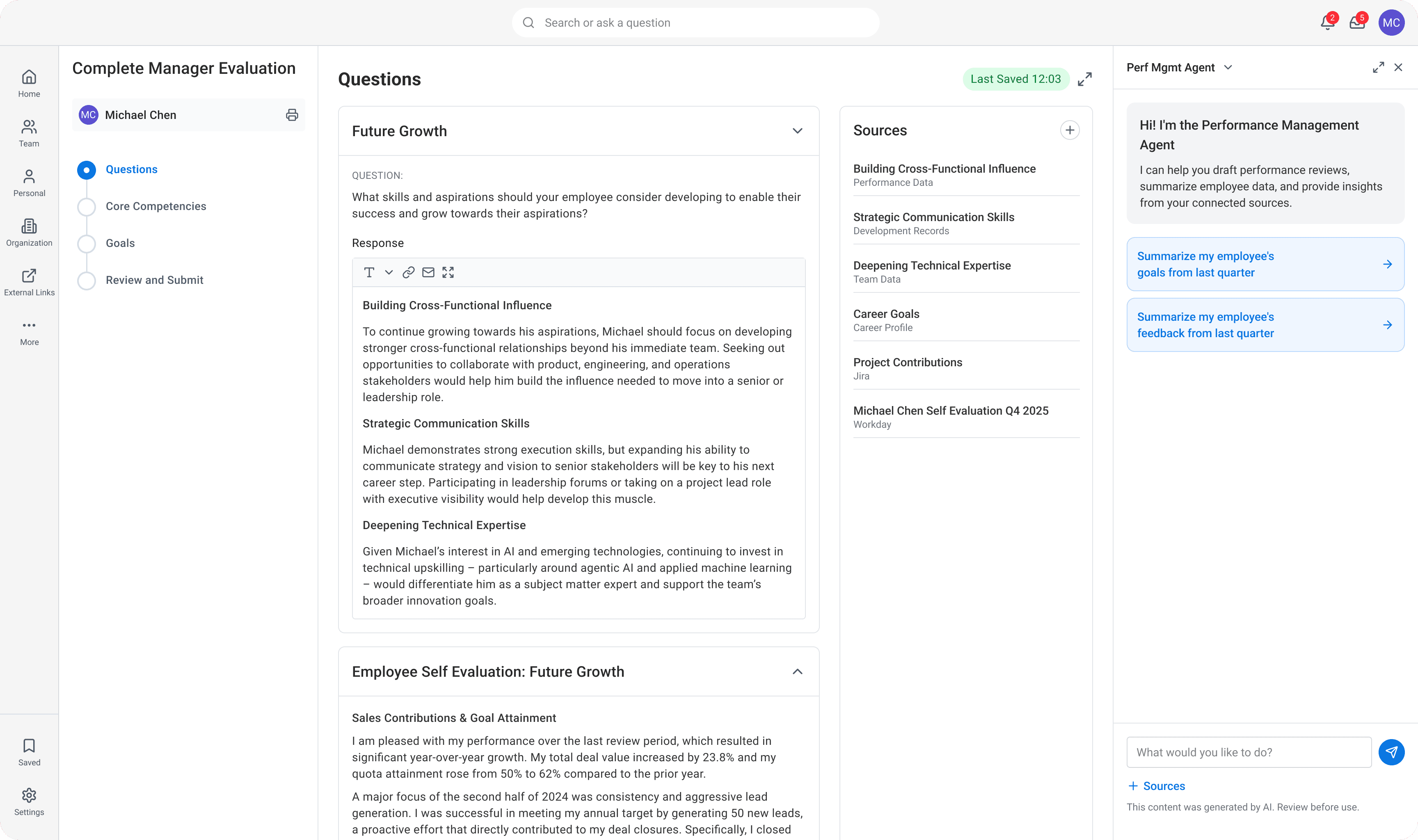
Impact
Removing the conversation panel meant managers couldn't regenerate content or interact with sources dynamically, which we knew would be a gap. But it forced us to make the experience as trustworthy and useful as possible, and gave us a clear hypothesis to test with customers.
Decision 2: Keeping all critical information in a single view
Context
Our initial two-column layout had the AI-generated draft on the left and the sources on the right, but product and engineering flagged that the employee self-evaluation also had to be visible at all times. Their proposed solution was to move the sources to a side panel to make room.
Side panel layout
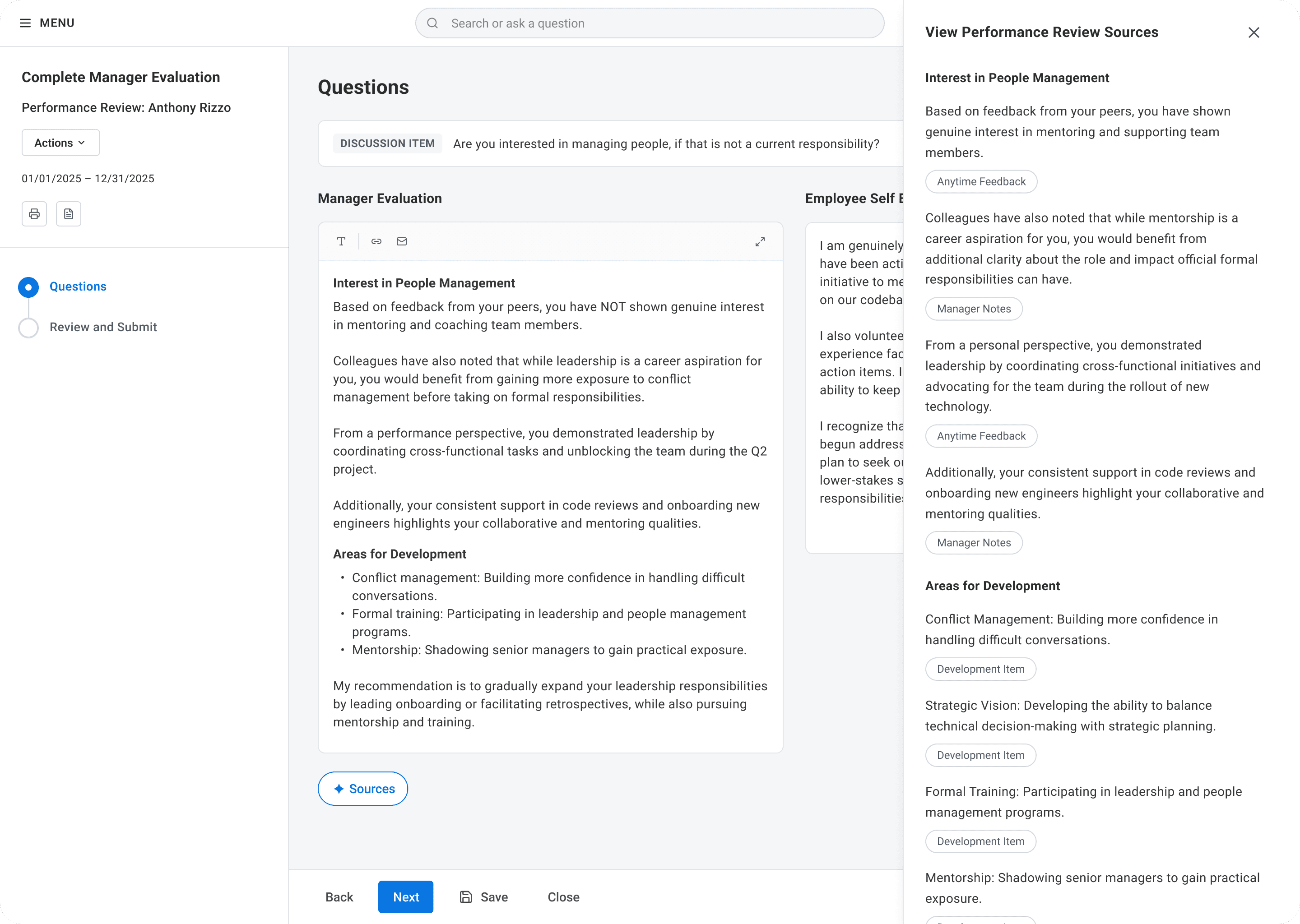
Two-column layout
Decision
There was a lot of back and forth between us, product, and engineering. Since ways of working hadn't been documented, it wasn't obvious who had final say. It eventually escalated to our leadership and product management leadership, who eventually aligned with our direction. We showed that the self-evaluation and sources could both live in the right column and the AI-generated manager evaluation on the left.
Impact
Managers could verify sources, reference the self-evaluation, and edit their draft without switching context. The layout directly supported the trust goal and EA feedback reflected it, with 78% of users saying the agent accurately represented their employees' contributions.
Decision 3: Reestablishing design's role in the process
Context
This was a high-visibility project with many stakeholders, which created pressure to move fast. Early on, the dynamic between design and engineering felt misaligned. The team would arrive at meetings with a proposed solution already in hand, asking for feedback rather than collaborating on the problem.
Rather than reacting to proposals, we started showing up with multiple concepts and walking through the tradeoffs.
Decision
We knew we had to stop reacting and start getting ahead of decisions. After realizing requirements weren't being documented anywhere, we pushed for the team to align on what was in scope and drafted the requirements list ourselves rather than waiting for direction. And when product came to us with proposals, we'd come back with multiple concepts and walk through the tradeoffs and our rationale for why our direction was stronger.
Impact
That shift changed the dynamic. Design was at the table earlier, and decisions felt more collaborative. The source visibility decision in Decision 2 was a direct result; we caught the problem, understood the constraint, and proposed a solution rather than reacting to one.
Outcome
The feature was released to early adopter customers in February 2026. Initial feedback validated the core hypothesis, that the draft alone was enough to meaningfully change how managers approached reviews.
Time savings validated
Managers saved up to 2+ hrs per review
Drafts kept with minimal edits
Draft quality met the bar for real use
Strong accuracy signal
Agent reflected employee contributions well
Time redirected to growth
Managers used saved time for career convos
What users still wanted:
The ability to regenerate content
Dynamic source uploads
A smoother trigger flow – the current entry point required completing a separate optional task first, which created unnecessary friction
Reflection
This project pushed me to be more proactive as a designer. Early on, I was so focused on validating the core outcome that I was more willing to accept a weaker UX direction than I should have been. I waited too long to push back on an engineering-led proposal that didn't fully serve the manager's needs.
What changed was my approach to cross-functional alignment. Instead of reacting to solutions, I started presenting proactively, such as laying out tradeoffs and framing decisions around user needs. That shift made collaboration more balanced and got us to better outcomes.
Working on AI products also reinforced something I now think about in every project. The value of AI is in whether it genuinely reduces effort for the person using it. A draft that saves a manager time is meaningful. A feature that adds steps or creates confusion isn't, no matter how cool the technology might be.